




We couldn’t find what you are looking for. Please try another way.
News
Thank you! Your submission has been received!
Oops! Something went wrong while submitting the form.
Announcing our 2025 Impact Report
News
Team Multiverse
Traditional education and training methods are struggling to keep pace. In this new world, Multiverse is committed to tackling these challenges head-on.
Our 2025 Impact Report takes a deep dive into how we are delivering learning that creates real-world impact, and helping people develop the skills they need to thrive.
We're supporting 22,000 learners to accelerate their careers and enabling over 1,500 customers to derive greater value by investing in their people to harness the potential of technology.
Impact for Customers
Multiverse provides solutions that not only address skills gaps but also deliver a tangible return on investment. We partner with clients to understand and address their specific skills needs, and develop personalised approaches to drive the adoption of technology.
We’re trusted by over a quarter of the FTSE100, half of Russell Group universities, 100 NHS trusts and 50+ local councils.
And our approach is delivering significant results:
- More than $2 billion in tracked ROI for our customers to date.
- $540 million projected ROI for learners enrolled this year.
- Productivity gains mean learners save one working month per year.
We empower businesses to unlock the full potential of their workforce. As Dan Jones, Portfolio Management and Operations, Director, Nationwide, puts it: “As we continue to invest in enhancing our technology and processes at Nationwide, it’s equally essential we place the same level
of investment in our people and their skills”
Impact for Learners
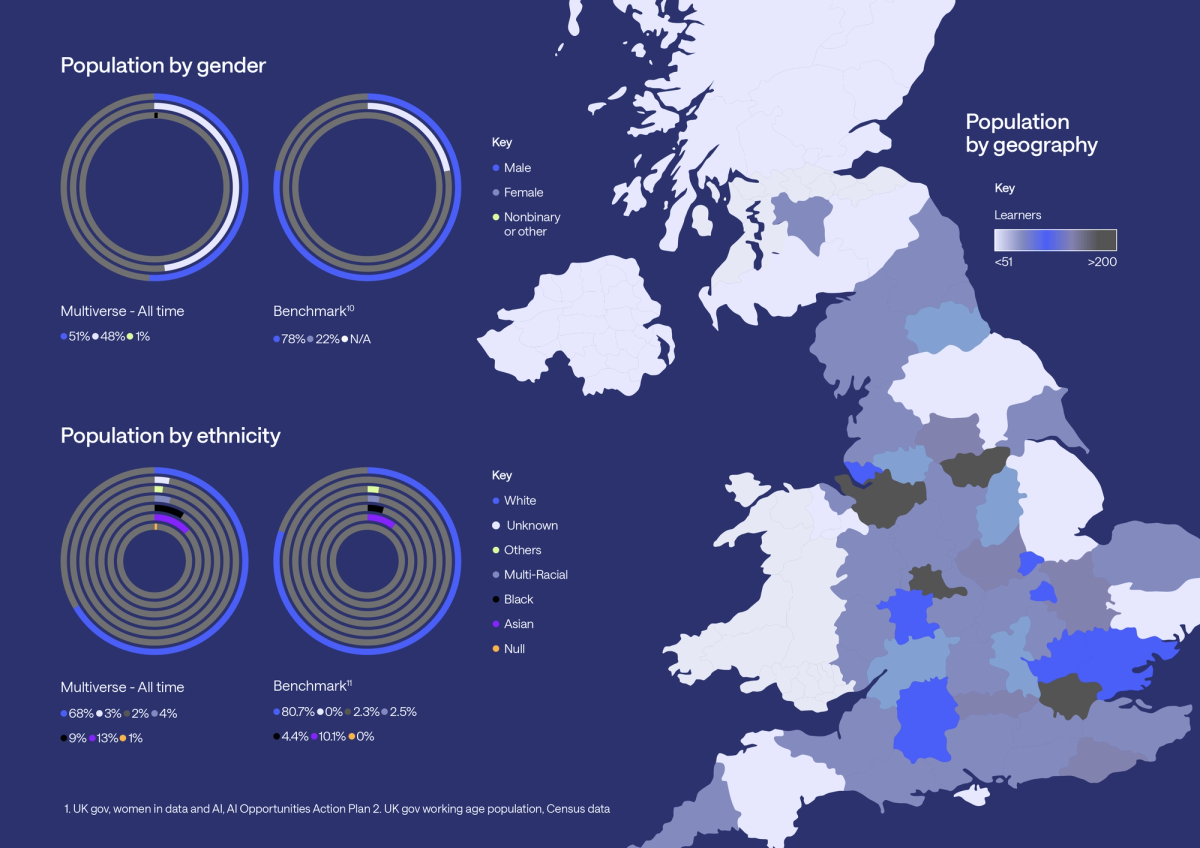
Multiverse provides pathways to acquiring valuable skills through applied learning and on-the-job experience. We recognise that traditional educational routes don't always cater to the diverse circumstances of individuals seeking to enter or advance within the workforce.
Our programmes deliver transformative outcomes for individuals:
- 1 in 2 learners (45%) received a promotion during their programme or in the 12 months after.
- 60% secured a pay rise.
- 98% achieved a pass or above in their programmes.
These outcomes highlight the potential of skills to help drive career advancement and social mobility.
As Harrison, an AI learner at Capita says: "AI has become a daily part of my workflow. Whether it’s automating tasks or improving efficiency, it’s saving me hours each week.”
Spotlight on AI
Businesses are investing in AI to the tune of $200 billion globally to drive efficiency and innovation. Employers want to meet the moment and seize the opportunity promised by productivity gains, and workers recognise the potential it has to catalyse their careers.
We want to make sure that the benefits of these skills are felt right across the population. And at the same time, we’re using AI to supercharge our own impact.
- We've launched five new AI programmes in the last 12 months.
- Our AI coach, Atlas, has received over half a million messages and has a 97% helpfulness rating.
- We are making AI skills accessible to everyone: almost a quarter of our AI learners have one or more contextual flags (23%), and our AI programs have a higher proportion of women than the sector average.

Multiverse's impact extends beyond individuals and businesses; we are also experiencing significant growth as an organisation. Our commitment to consequential learning drives us to innovate, scale our operations, and expand our reach, all while staying true to our mission of providing equitable access to economic opportunity.
Want to find out more? Read the report.
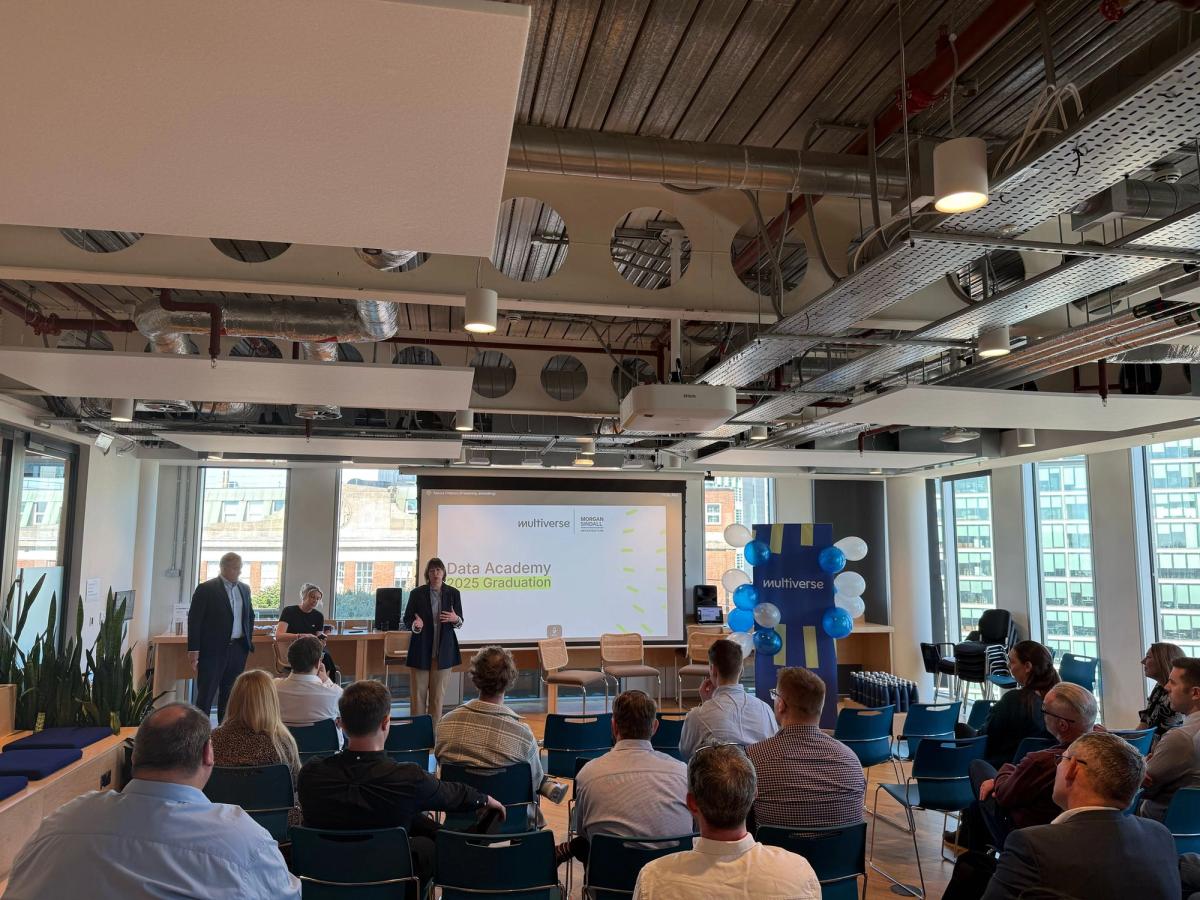
Morgan Sindall Infrastructure builds out data academy as upskilling initiative saves 7,200+ hours annually
News
Team Multiverse
Morgan Sindall Infrastructure today announces that it will build out its data academy with Multiverse, following the success of its graduating apprenticeship cohort.
In a move that will continue to boost business potential through data-driven decision making, the upskilling initiative marks Morgan Sindall Infrastructure’s continued commitment to investing in its people. The forthcoming launch will bring the total number of employees who have enrolled on digital and data programmes with Multiverse to 80.
Impact across the business has been substantial since the inception of the academy. The most recent cohort saw a 14% increase in individual efficiency during the programme – equating to more than 7,200 hours saved per year. Apprentices have used improved data skills to drive tangible business outcomes, from mitigating weather-related project delays, to reducing workplace safety incidents, to increasing visibility of potential quality issues. Following their completion of the programme, 86% of the graduating cohort achieved a distinction.
One apprentice who drove significant impact on programme is James Macdonald, who developed skills in Python, SQL and PowerBI. He said: “I’ve already benefited from learning how to conduct hypothesis tests and build regression models in Python. I’ve been able to apply this in my work on our carbon calculation tool, to predict the carbon footprint of forthcoming projects, which will be really valuable. And elsewhere I’ve already seen value in data skills reducing time spent gathering information for reporting dashboards.”
Multiverse’s 2024 Skills Intelligence Report revealed that in construction, 29% of employees’ time working with data is spent unproductively. Morgan Sindall Infrastructure’s continued commitment to upskilling, however, will enable its teams to automate processes and tasks, leading to a significant boost in efficiency and output.
Sarah Reid, Managing Director - Water & Highways at Morgan Sindall Infrastructure said: “The Digital and Data Academy is part of our ongoing commitment to developing and protecting our people, ensuring they have the right tools and knowledge to thrive in a fast-paced industry. Having the skills to harness data effectively will not only improve efficiency across the business but also create opportunities for personal and professional growth.”
Multiverse combines work and learning to unlock economic opportunity for everyone. It works with more than 1,500 organisations to close critical skill gaps in the workforce in AI, data and technology.
Gary Eimerman, Chief Learning officer at Multiverse said: “Data is transforming the future of the construction industry. By taking a forward-thinking approach to close the data skills gap, Morgan Sindall Infrastructure will deliver measurable benefits for both its business and its people.”

King’s College London bolsters digital transformation with new Digital and Data Academy for staff
News
Team Multiverse
King’s College London is upskilling 75 of its staff through a new Digital and Data Academy in partnership with Multiverse. The initiative will support the University’s ongoing digital transformation, which includes the review and automation of time-intensive tasks.
The Digital and Data Academy will enhance skills in key areas such as professional services technology and academia, further strengthening the organisation’s ability to make data-informed decisions to improve service provision to both students and staff. Once accredited, the cohort will have increased capacity to focus on the most impactful and strategic elements of their roles.
Training is funded by the apprenticeship levy and delivered by Multiverse, a tech company that specialises in high-quality training through applied learning. Multiverse has trained more than 20,000 apprentices at over 1,500 organisations in data, AI and digital skills since 2016.
The 75-strong cohort will undertake Multiverse’s Level 4 Data Fellowship for professionals looking to establish or develop core data skills. At the end of the 13-month programme, King’s College London employees will have strengthened skills to support accurate, data-informed decision making while confidently using visualisation tools like Power BI.
According to Multiverse’s Skills Intelligence Report, the education sector is impacted by a lack of data skills, with 38% of employees’ time working with data spent unproductively, compared to the average of 30% across 18 other sectors. King’s College London’s new Digital and Data Academy will seek to proactively address this ahead of current sector concerns.
Kirti Swift, Deputy Director - Organisational Development at King's College London said: “Through this academy, we are strengthening a culture of data literacy and digital capability across the university. This will enable smarter decisions, deeper insights, and more efficient ways of working - freeing us to focus on what truly matters: enhancing the experience and outcomes for our students and staff.”
Isabelle Leung, Senior Research Grants Administrator at Kings College London, who is enrolled in the apprenticeship, said: “My team leverages data from across multiple systems daily, identifying and resolving problems or discrepancies. This training has already allowed us to streamline processes, improve accuracy and drive efficiencies, reducing the turnaround time of our monthly reviews from one week to just two days.”
Multiverse combines work and learning to unlock economic opportunity for everyone. It works with more than 1,500 organisations to close critical skill gaps in the workforce in AI, data and tech, through a new kind of apprenticeship.
Gary Eimerman, Chief Learning Officer at Multiverse said: “King’s College London is a global epicentre of exceptional research and innovation, led by the finest professionals. It has identified an opportunity to strengthen its operations through an enhanced understanding and utilisation of data – our Data Fellowship program is designed to help individuals on their team for exactly this.”
Multiverse and Skillable launch partnership to enhance hands-on, job-embedded learning at scale
News
Team Multiverse
In today’s fast-changing workplace, traditional training methods no longer suffice. As AI automates routine tasks, employees must develop higher-order skills such as critical thinking, problem-solving, and the ability to apply technical knowledge in context.
Multiverse and Skillable are joining forces to bridge the divide between learning and real-world application. This partnership integrates Skillable’s hands-on virtual labs with Multiverse’s structured coaching model, creating an immersive ecosystem where learners gain both theoretical knowledge and practical, scenario-based experience. By combining strengths, Multiverse and Skillable empower employers with a scalable solution that ensures professionals can confidently apply technical skills in real-world settings—reinforcing their shared philosophy that people learn best by doing.
Gary Eimerman, Chief Learning Officer at Multiverse, added, "Our partnership with Skillable expands our experiential learning approach by providing practice environments that mirror real-world use cases. Coupled with our coaching, Skillable's virtual labs allow us to create experiences where learners can safely practice technical skills before applying them in production environments."
Through this collaboration, apprentices benefit from structured skill-building experiences that provide immediate feedback, with the ability to reset and try again without consequences—creating low-pressure learning opportunities that build confidence. These experiences are further enriched by Multiverse's personalized coaching, which helps learners connect technical skills to broader business contexts.
Frank Gartland, Chief Product and Technology Officer at Skillable, remarked, "Our partnership with Multiverse represents an exciting opportunity to enhance their industry-leading apprenticeship model with our hands-on virtual lab technology. Together, we're creating a learning experience combining the best of human coaching with immersive scenarios that stretch skills and bolster confidence, giving learners both the guidance and practical experience needed for ongoing success in today's digital economy."
The partnership will launch with Multiverse's Applied Data Engineering (ADE) apprenticeship program, the latest addition to its portfolio of data skills products. This program exemplifies how the combined approach elevates learning outcomes: learners gain hands-on experience in data infrastructure management through Skillable's customizable labs, while Multiverse coaches provide strategic guidance on applying these skills to real business challenges.
Learners in the ADE program gain hands-on experience managing complex data infrastructure, developing advanced pipelines, securing databases, implementing rigorous data governance, and even applying machine learning to enhance data solutions—all within Skillable's safe learning environments that protect critical production systems and sensitive data. Throughout their learning journey, Multiverse's expert coaches provide targeted support, helping employees translate these technical skills to their organization's unique environments and technology stacks. This powerful combination bridges the gap between controlled practice and real-world application, ensuring apprentices can confidently implement their new capabilities using their organization's specific tools, processes, and business context.
As the workforce continues to adapt to new technologies and business challenges, Multiverse and Skillable are committed to delivering the hands-on, outcome-driven learning environments needed to thrive. With plans to expand across technical domains, including cloud computing and AI, this partnership marks the start of a new era in applied learning—where talent development is measured not by knowledge alone but by the ability to deliver results.
First comprehensive analysis of FTSE100 annual reports reveals substantial skills gap
News
Team Multiverse
Most of the UK’s largest listed companies are underprioritising skills development in relation to technology, according to new Multiverse analysis of a sample of FTSE 100 annual reports spanning the last 10 years.

Despite seven in ten FTSE 100 companies mentioning a strategic priority relating to technology, only 7% describe skills and training as a strategic priority in their latest annual reports. This proportion has not improved since 2013 (6%), while technology has shot up, suggesting that boardrooms are not yet recognising the sweeping impact of technology on workforce skills and people requirements.
With Goldman Sachs predicting that AI investment will rocket to $200bn this year, companies who do not act are potentially putting record levels of investment at risk.
To uncover this data, Multiverse’s data science team worked with expert data analyst David Abelman (ex-Meta, Bain & Company), to build a Large Language Model (LLM) system to analyse structured information from over 100,000 pages of publicly available annual reports. The resulting Boardroom Skills Agenda report provides empirical evidence on how people and skills are missing from the boardroom’s top priority list.
The missing skills piece
Where companies do proactively reference skills strategies, they are often not undertaking reviews of the existing skills capabilities of their workforce. Only 17% describe running skills reviews of their workforces in the latest reports, while 78% of companies reference reviewing their Board of Directors’ skills.
According to the report, companies are also not targeting skills development relating to the most consequential technologies that will shape the future of work. For example, while 97% of companies mention critical compliance and DEI training, only 34% of companies referenced Artificial Intelligence (AI) training.
These findings follow Institute for Fiscal Studies (IFS) reporting, which confirms that the average number of days of workplace training received each year has fallen over the last decade. Employer spending on training has decreased over the same period, and there has been a fall in both public and private investment in training.
Meanwhile, growth is top of the UK’s political and economic agenda, with the Government promising to break down the current barriers to equipping the workforce with the right skills to maximise new technologies.
Euan Blair, CEO of Multiverse, said:
“Annual reports are a weathervane for the issues that are capturing the boardroom’s attention. What we can see in the data is that investment in technology is skyrocketing but skills and training has stagnated. It’s telling that at the same time, so has UK productivity.
“Technology tools are only as powerful as the people who use them. Without prioritising people, companies will be left with tech strategies that are missing a key piece of the puzzle. The tech revolution will not arrive until companies connect the dots between tools and talent.”
Further headline findings from the Boardroom Skills Agenda report include:
Technology is impacting workforce skills, despite absence from boardroom top priority list
The growing impact of technology on the workforce is starting to be signalled in some reports, with discussion of “reskilling” and technical “upskilling” on the rise. Yet overall the incidence and prioritisation of technical skills initiatives is notably still low.
- The proportion of companies mentioning reskilling has nearly tripled in the last 10 years from 7% to 20%, while technical upskilling has more than doubled (23% to 51%).
- Yet in the most recent set of annual reports, only 10% of companies provided a sum for how much they were investing in training.
- When referenced, the average (median) spend was £600 per employee. A median of just 0.16% of company revenue was spent on training, and only 1% of working hours.

Apprenticeships overtake graduate schemes
The AI analysis also found that companies are delivering training via a number of different schemes, and referencing these schemes more than they were 10 years ago:
- 59% of companies referenced an apprenticeship scheme (vs 48% 10 years ago), while 48% have a graduate scheme (vs 39% 10 years ago).
- Meanwhile, 32% said they had an internship scheme (vs 19% 10 years ago).

David Abelman, Data Science Consultant, added:
“When implemented carefully, LLMs provide a fantastic way to extract quantitative information from textual documents at scale. We were able to craft a workflow to make sense of over 100,000 pages of annual reports, giving us a unique understanding of how companies discuss their people development in relation to their increasingly strategic prioritisation of technology.
“It was clear that whilst technological focus has ramped up, strategic skill development is generally lagging behind. But it’s also promising to see signals of change in the tactical implementation of learning and development initiatives. It will be fascinating to see how this plays out in the coming years as the increasing impact of AI is felt.”
Download the full report.

New Data Academy to boost student success and staff satisfaction at Buckinghamshire New University
News
Team Multiverse
Buckinghamshire New University is launching a Data Academy for 35 of its staff members in a bid to enhance employee experience, maintain student satisfaction and grow student numbers.
By building a data-driven culture in areas such as admissions and academic registry, upskilled employees will support in achieving some of the university’s strategic milestones, including retaining its place as a top 10 university in National Student Survey student satisfaction rankings.
Training is being delivered by Multiverse, a tech company that identifies, closes and prevents skills gaps, through personalised, on-the-job learning. Multiverse has trained more than 20,000 apprentices in AI, data and digital skills since 2016.
According to Multiverse’s Skills Intelligence Report, the education sector has the highest rate of time lost to unproductive data tasks. For Buckinghamshire New University, time-consuming manual processes previously impacted staff’s ability to spend time on more value-added tasks, while data silos led to inconsistent ways of working. By upskilling its employees in data, the university will be able to optimise processes and significantly increase productivity.
Employees will be enrolled on two Multiverse programmes. The Level 3 ‘Data & Insights for Business Decisions’ course will give staff the skills to understand data quality, apply automation to reduce silos and save time, while also managing organisational change and influencing behaviour across the organisation. The more advanced Level 4 ‘Data Fellowship’ will upskill university staff in computer programming, data modelling, integration and analysis techniques, with an introduction to machine learning and predictive analytics.
Jon Lees, Academic Registrar at Buckinghamshire New University, said: “At BNU, we are committed to investing in our staff talent. Our collaboration with Multiverse will help deliver on this, as we build our staff’s expertise and professional practice, and continuously improve our organisational effectiveness. As we launch our first cohort, we look forward to seeing positive change take place, led by data skills for the modern workplace.”
Multiverse combines work and learning to unlock economic opportunity for everyone. It works with more than 1,500 organisations to close critical skill gaps in the workforce in AI, data and tech, through a new kind of apprenticeship.
Gary Eimerman, Chief Learning Officer at Multiverse said: “Buckinghamshire New University has a rich heritage in transforming student lives and has recognised how more effective data management has the potential to contribute to this. By investing in the development of its staff, Buckinghamshire will be able to accelerate progress in meeting its strategic objectives.”
Skanska UK is building for the future with digital Academy
News
Team Multiverse
Together, Skanska UK and Multiverse have already trained over 50 employees through specialist learning opportunities enhancing skills. This latest addition will further enhance skills across the organisation and contribute to delivering Skanska UK’s digital transformation strategy.
Sally Scott, Director of Talent and Capability at, Skanska UK: “Through this partnership we are equipping our people with the knowledge and skills to ensure our projects deliver on time and to cost and quality expectations, making faster, data informed decisions. Our Data apprenticeships are now joined by a new AI apprenticeship, enabling more colleagues the opportunity to upskill.”
The training is being delivered by Multiverse, a tech company that identifies, closes and prevents skills gaps, through personalised, on-the-job learning. Multiverse has trained more than 20,000 apprentices in AI, data and digital skills since 2016.
The expanded Academy offers programmes such as the Level 3 apprenticeship ‘Data & Insights for Business Decisions’, covering core technical skills including cleaning, formatting and preparing data. The Level 4 ‘Data Fellowship’ lays the foundation for apprentices to become high-performing analysts and data science professionals.
Skanska UK is also leading the way on developing skills in AI in the construction sector, launching a first cohort onto Multiverse’s ‘AI for Business Value’ programme. AI will be taught as an tool to understand opportunities for ensuring profitability and predicting performance, while reducing manual processes to free up time for skilled workers.
According to the Multiverse Skills Intelligence Report, the UK construction industry currently contends with nearly a third of employees' time working with data being spent unproductively. Through upskilling, Skanska UK will help deliver more effective outcomes for customers and in turn help it compete in an increasingly data-driven construction sector.
Tom Gould, Operational Efficiency Director, at Skanska UK said: “From enhancing project timelines to optimising resource allocation, we recognise the transformative role data has in construction. Working together with Multiverse we are expanding learning opportunities for our people, ensuring we continue to deliver efficient and cost-effective solutions to clients and remain on the leading-edge of an evolving industry.”
Gary Eimerman, Chief Learning Officer at Multiverse, said: “It’s fantastic to see the value that Skanska has gained from our long-running partnership. In expanding the Data Academy to more employees, and exploring the opportunities afforded by AI, Skanska is seizing the opportunity to build for the next era of construction. In this new era, digital skills will be a catalyst for improved operations throughout the industry, from project development to sustainability and beyond.”

Continuous learning at every age and every career stage: Gen Z just as anxious as their parents about getting overtaken by younger, more tech-savvy workers
News
Team Multiverse
In this environment, a single shot of learning early on in life is clearly no longer sufficient.
Instead, we need to embrace a model of lifelong learning, where opportunities for growth and development are available to people of every age and at every stage of their career. That’s why at Multiverse, we deliver programmes that enable everyone to benefit from continuous, applied learning.
In the lead up to National Apprenticeship Week, we commissioned new polling with Public First to understand more about how people perceive their career journeys, from early career starters to more experienced workers - and found some surprises along the way…
Gen Z are just as worried as their parents about the threat of more tech-skilled workers
The rapid pace of technological change, particularly in the field of AI, has led to a widespread feeling of anxiety about being "left behind". And you might expect that this would be significantly more common among older generations.
But no: this concern isn't limited to older workers. It spans across ages and career stages.
Gen Z are similarly likely to think that they’re being overtaken by tech-savvy younger workers as those their parents’ age, with nearly a third of 18-24s expressing agreement compared with a third of the 45-54s.

This tech anxiety is also more pronounced in those who have taken extended leave from the workplace. Women who took extended leave are more likely than average to say they think they are perceived as not tech-savvy (37% vs 34%), and that they’re being overtaken at work by younger, more tech-skilled workers (38% vs 33%).
Career progression slows as you grow — but should it?
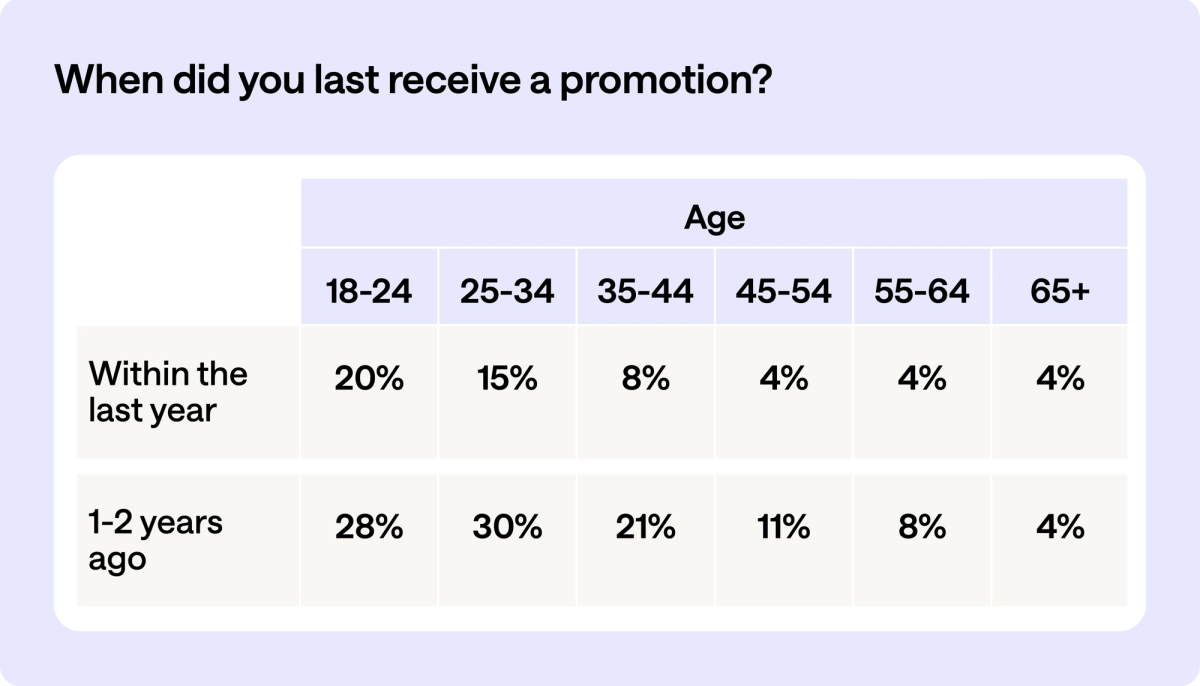
Our research found that those in the first decade of their career (18-24-year-olds) have seen much greater recent progression than those approaching the last decade of their career (55-64s).
Nearly half (47%) of career starters told us they have been promoted within the last two years, compared with just 12% of the 55-64s.
This career plateau needn’t be the case. Particularly with the UK government’s ambitions for growth and boosted productivity, there is no reason why more experienced workers shouldn’t also be enabled to seize the skills opportunity alongside their early career counterparts. After all, AI wasn’t around when most older workers began their careers.
In their working lives they’ve been witness to the death of the fax machine, the rising tide of email, the advent of the internet and the move to mobile. And they’ve tackled them all. Who says there’s such a thing as too old for AI?!
With this stark data, it’s perhaps unsurprising that more than two in five workers aged 55-64 (42%) express negative feelings towards their current pay level, and the availability and frequency of payrises (49%) and promotions (44%). Reskilling could be a solution: not just for individuals. Imagine the national economic upside if those in the last decade of their careers were promoted with the same frequency of those in their first.
More experienced workers recognise the need to reskill in tech
Despite feeling like they are not a priority for training and development (two in five agreed), older workers are more keen to develop their digital and AI skills than younger cohorts.
While some people might have the perception that older generations are tech-resistant, this data demonstrates loud and clear the fact that age doesn’t correlate to willingness to learn new skills.
Women who took an extended period of leave from work are also more likely than average to say that they need training at work to become capable of using new tech (45% vs 37%). They also express the desire to gain improved digital and AI skills from training.
These differences in priorities highlight the need for tailored approaches to skills development, ensuring that everyone, regardless of age or career stage, has access to the training they need to succeed. This was one of the core principles included in our Skills Mission report - we know from polling we commissioned last year that 9 in 10 workers support the right to reskill.
Taking learning out of the classroom and into the workplace
The evidence is clear: learning shouldn't be a one-time event. By prioritising continuous learning, we can help to ensure that there is equitable access to economic opportunity for all.
This helps employers - because it offers them a more skilled and engaged workforce, who they’re more likely to be able to retain.
And it helps learners - because it empowers them with the tools they need to succeed in a world brimming with change.
You’re never too old to try something new. You’re never too young to recognise the substantial effects of technological change.
Methodology
Public First online survey commissioned by Multiverse for the period 17 to 21 January 2025 with 2011 participants. All results are weighted by interlocking age and gender, region, and social grade to nationally representative proportions.
Northwell Health stays ahead of the AI curve through an upskilling partnership with Multiverse
News
Team Multiverse
The companies which embrace these changes and proactively equip their teams with the necessary skills will be the ones who thrive. It’s selecting the right routes to make it happen that is hard.
Northwell Health has partnered with Multiverse to upskill across its information technology workforce to ensure they are familiar with and ready to use the latest, most powerful tools. The training has expanded employees’ skill sets and boosted their productivity, translating to real world impact: money savings and improved operational efficiency.
Through this development partnership, Northwell Health is providing its employees the opportunity to learn new skills and grow their careers through highly personalized training.
The training is being delivered by Multiverse, a tech company delivering high-quality training through applied learning, to 155 Northwell Health learners. Each learner's unique pathway is designed to help them develop their ability to make use of data and AI in a real world setting.
It focuses particularly on realizing the value from the latest data and AI tools, from Microsoft 365 Copilot, to Tableau and PowerBI.
By teaching its employees these critical new skills, Northwell Health is building an AI-native workforce capable of reimagining workflows and business processes. As they explore new AI and data skills, learners believe that they will become more efficient. Already some are reporting they will spend 6 hours less a week on tasks that had previously required manual inputs, and inefficient working practices.
One Northwell Health learner said: “I had no idea what AI could do or how it worked, but now that I understand it better I can see it being valuable in the future for other things I do day-to-day.”
This program has already helped Northwell learners reconfigure their understanding of AI tools and how they can incorporate them in their work. By upskilling their workforce, Northwell Health has supported its employees’ career growth and enabled them to deliver on critical business goals, improving operational efficiency and the company’s bottom line.
Brian Aquart, Northwell Health’s Vice President of Workforce & Community Education said: “We are so excited by the opportunities that this partnership brings for our employees to harness the power of AI to grow their careers and help the company reach its business objectives.”
“Many companies are working towards developing AI native workforces, but Multiverse’s approach to identifying, closing, and preventing skills gaps at scale while delivering against unique business goals has enabled us to continuously analyze and address our skilling needs.”
Elina Petrillo, VP HR Technology, said: “Creating a culture of continuous learning is essential in today’s fast-evolving workplace. By empowering our team to assess their skills and proactively learn new ones, we are fostering growth and driving efficiency. With rising healthcare costs, it’s more important than ever to enable employees to complete tasks faster and strengthen workforce data and software engineering capabilities. Newly acquired skills don’t just improve individual performance—they allow employees to contribute in new, meaningful ways. For just one team at Northwell, upskilling has led to increased productivity and engagement.”
Euan Blair, CEO of Multiverse said: “Northwell Health is a proven leader when it comes to innovation in healthcare. By upskilling its information technology workforce, Northwell is working towards building an AI native workforce capable of transforming and improving its business while ensuring their employees have the skills they need to leverage emerging technologies and to progress in their careers.”
Introducing our AI principles
News
Anna Wang
Artificial Intelligence is transforming the world of learning. The burning need for companies and societies to increase productivity and generate new growth through additional AI capabilities, and the skills to deploy them, is the discussion heard from boardrooms to watercoolers across all industries.
At Multiverse, we believe that AI isn’t just the cause of new skills requirements, it’s also the solution.
AI makes personalized, always-on coaching available at scale. It can assist in tailoring learning materials so that individuals get the education they need to achieve their individual goals. It can reduce burdens on educators by supporting on non-core tasks, so they spend more time supporting learners.
So we have put AI at the heart of what Multiverse does for employers and learners. Whether that’s our AI-driven skills diagnosis that translates business goals into personalised learning pathways for individuals, or Atlas, our always-on coach, that works with our expert human coaches to accelerate equitable outcomes for our learners.
Now it’s time to share the principles for the Multiverse approach to AI. We’re choosing now for two reasons:
- The future of Multiverse involves more AI, not less. Given the success of our initial investments in AI, we’re confident that the next phase of Multiverse will involve additional integrations of AI solutions into what we do. Clear principles help guide our teams as they experiment, build and deploy.
- Transparency for our users. AI adoption will be more successful if its users understand the fundamental motivations behind it.
The Multiverse AI Principles
The following principles outline how we’re thinking about the way we build with AI, now and in the future.
AI first
Our AI features are increasingly core to our product offering. We will continue to build with AI as a fundamental driver of how we deliver an outstanding learning experience, woven into the fundamentals. It is not simply a supplement to the experience or just an enabler of things we’d otherwise want to build.
Contextualised
Our AI solutions are contextualised to our customers and our users. Personalization sits at the heart of being able to educate at scale, and this is a key benefit of leveraging AI.
Fair and non-discriminatory
Our mission has equitable access at its heart, and AI at Multiverse will be no different. When we deploy AI solutions for learning environments we seek to do so with fairness and in a non-discriminatory manner. We firmly believe that it is necessary for AI to neither create nor reinforce bias.
Consequential
At Multiverse we believe the principle value of learning is in the real world application of skills, and the tangible consequences of that application. The same is true of our approach to AI. We will only incorporate AI systems in our products when we have a deep conviction that they will drive real world value. Our AI should be a tool, not a toy.
Transparent
We want our AI systems to be explainable, to foster confidence in their outcomes for both Multiverse and our learners. When we deploy AI, we will ensure it is underpinned by a robust understanding of the logical steps and rationale behind its decisions, including its capabilities and limitations.
Human in the loop
Multiverse AI will always be built and run with the careful guidance of Multiverse people - for feedback, direction and fairness. We want AI to complement and enhance the expertise of our coaches, tech talent and customer support teams, not replace it. This commitment ensures that AI complements human judgment rather than replacing it, allowing us to harness the best of both worlds.
How Multiverse uses these guidelines
Our principles are core to how we are building AI systems at Multiverse, but they are not intended to be static; they will evolve as our understanding of AI and its impact on learning grows. We are dedicated to continuously evaluating our AI implementations and training methods to ensure they remain aligned with company values and ethical responsibilities, as well as our compliance and legal obligations.
These principles have been inspired by input from both our AI Advisory Board, and the Multiverse Customer Advisory Board. As a result, we may update our principles in line with updated inputs.
The end goal: empowering learning and growth
Ultimately, our AI principles are about more than compliance; they are about fostering a culture of learning and growth for our team, for the benefit of our customers and learners. We see AI as a powerful ally in personal and professional development. By embedding these principles into every aspect of our AI strategy, we aim to create a learning ecosystem that not only prepares individuals for the future, but also contributes to society.
At Multiverse, our commitment to the principled use of AI is coupled with our core mission: to create equitable access to economic opportunity, for everyone. As we move forward, our partners are with us on the journey.
Sorry, no results found.